Senate Approves Kevin Warsh for Federal Reserve Board as Trump Moves to Reshape Central Bank Leadership
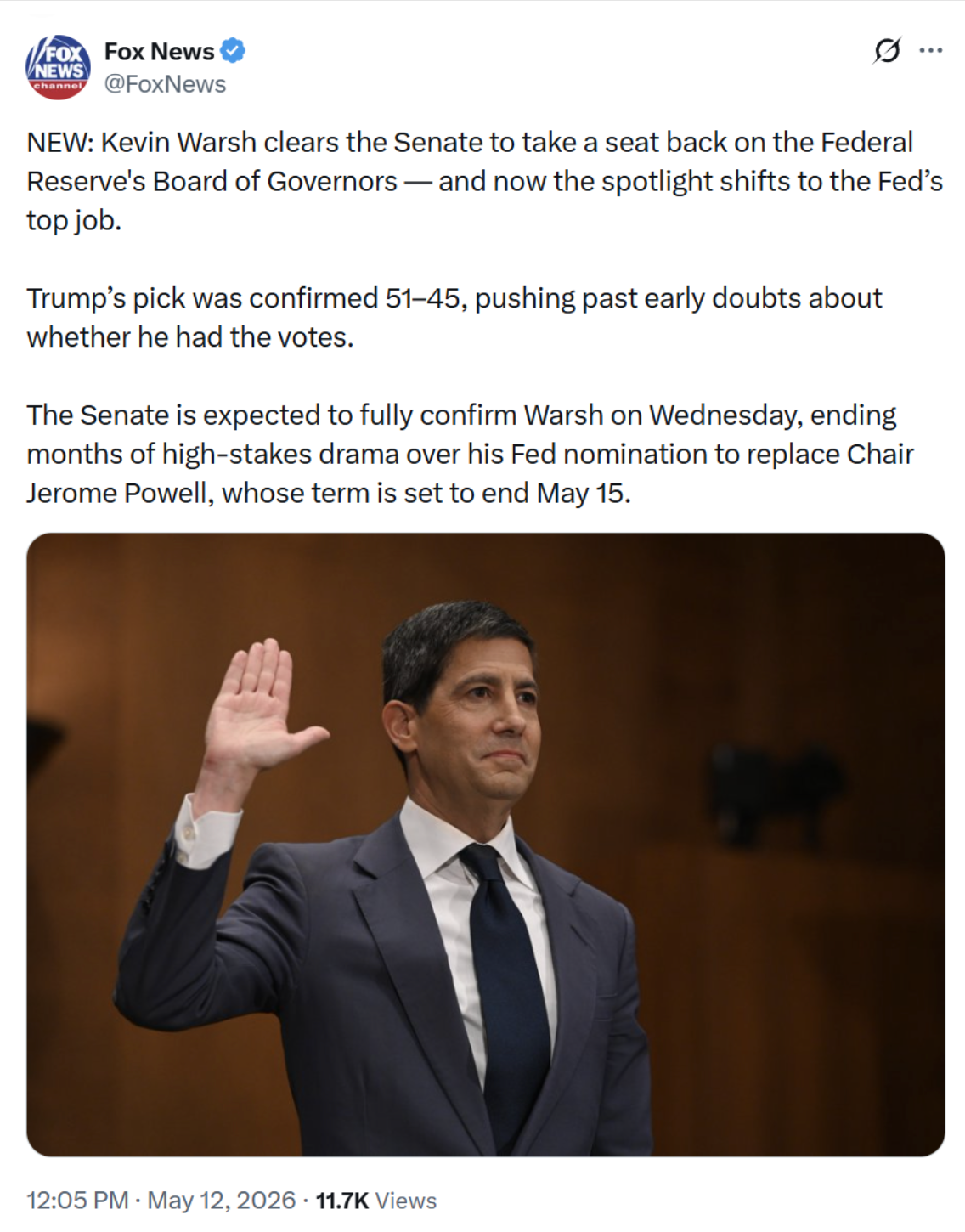
The Senate voted Tuesday to confirm Kevin Warsh to the Federal Reserve’s Board of Governors, advancing President Donald Trump’s effort to install new leadership at the nation’s central bank following months of controversy surrounding outgoing Fed Chair Jerome Powell.
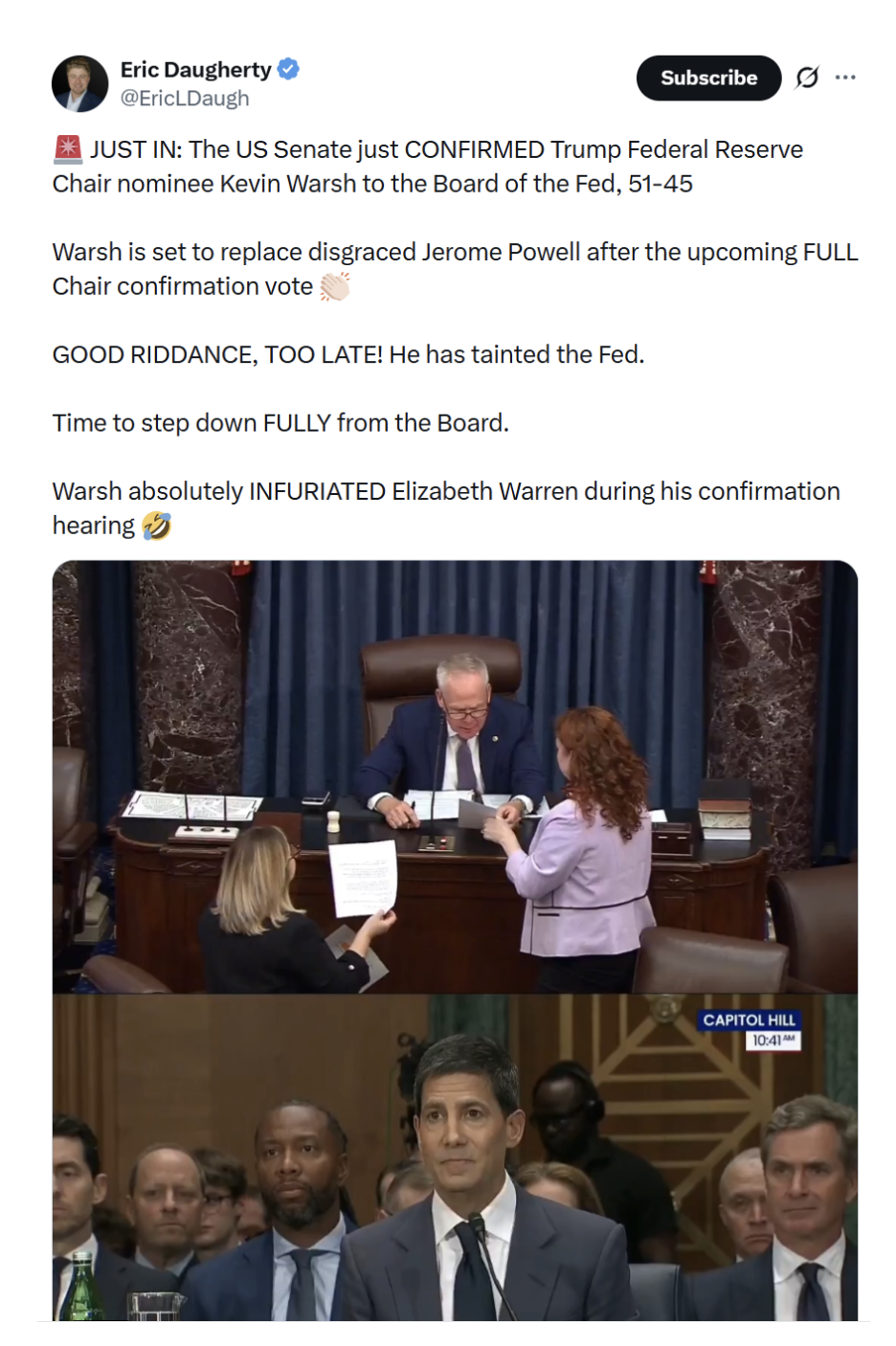
Warsh was confirmed by a 51-45 vote to serve a 14-year term on the seven-member board, giving the Trump administration a stronger foothold inside one of Washington’s most influential economic institutions.
The Senate is still expected to hold a separate confirmation vote later this week on Warsh’s nomination to become chairman of the Board of Governors, replacing Powell when his four-year leadership term expires Friday.
President Trump has already publicly joked about issuing Warsh his “first orders,” underscoring the administration’s desire for a more growth-oriented monetary policy after years of tension with Powell’s leadership at the Fed.
Warsh will assume the board seat previously occupied by Stephen Miran, a Trump ally who joined the central bank last year after an early resignation created an opening. Miran’s official term expired in January, though he remained on the board until a successor was confirmed.
Before joining the Fed, Miran served as chairman of the White House Council of Economic Advisers and temporarily stepped away from that role to assist with the administration’s economic agenda at the central bank.
Warsh’s new term as governor will run through 2040.
A graduate of Stanford University and Harvard Law School, Warsh is no stranger to the Federal Reserve system. He previously served as a Fed governor during the height of the 2008 financial crisis before leaving the institution in 2011.
Since then, he has built a prominent career in finance and public policy, serving as a fellow at the Hoover Institution and advising billionaire investor Stanley Druckenmiller.
Warsh is also married to Jane Lauder, granddaughter of cosmetics entrepreneur Estée Lauder. Reports estimate the couple’s net worth exceeds $100 million.
Throughout the past several years, Warsh has emerged as one of the Federal Reserve’s most vocal critics. He has repeatedly challenged the size of the Fed’s balance sheet, questioned the institution’s regulatory approach toward banks, and criticized how the central bank communicates monetary policy to the public.
At times over the past year, Warsh has also signaled openness to reducing interest rates in order to support economic growth, though during his earlier tenure at the Fed he was widely viewed as a monetary hawk focused on containing inflation and preventing excessively loose policy.
President Trump has repeatedly pushed the Federal Reserve to lower rates more aggressively, arguing that unnecessarily high borrowing costs hurt American workers, consumers, and businesses. The president has sharply criticized Powell in recent months, referring to him as a “moron” and a “stubborn mule” over the Fed’s refusal to rapidly ease rates.
The Federal Reserve faces a delicate balancing act when setting monetary policy. While lower interest rates can stimulate economic expansion and investment, they can also contribute to rising inflation if handled improperly.
Every interest-rate decision made since Miran joined the Fed board last fall reportedly drew dissent from him, as he consistently argued in favor of deeper rate reductions.
Despite those objections, the Fed’s 12-member Federal Open Market Committee has left rates unchanged during all three of its meetings this year. Even during the final three meetings of 2025, when the Fed approved rate cuts, Miran maintained they should have been more substantial.
During his confirmation hearings, Warsh sought to reassure lawmakers that he would preserve the Federal Reserve’s independence in setting monetary policy.
He testified that Trump “never asked me to predetermine, fix or decide on any interest rate decision, nor would I ever do so.”
“I will be an independent actor if confirmed as chair of the Federal Reserve,” he said last month.
As a Fed governor, Warsh will join a board that currently includes two members nominated during President Trump’s first term and three appointees selected by former President Joe Biden.
The Trump administration has also attempted to remove one of the Biden-era nominees from the board, though those efforts remain tied up in court proceedings.
Powell, meanwhile, has not indicated whether he intends to remain on the Federal Reserve board after stepping down as chair. His current board term does not expire until January 2028.
He previously stated that he intends to maintain what he described as a “low profile.”