Texas Senate Bombshell - Early Voting Numbers Released And Wow
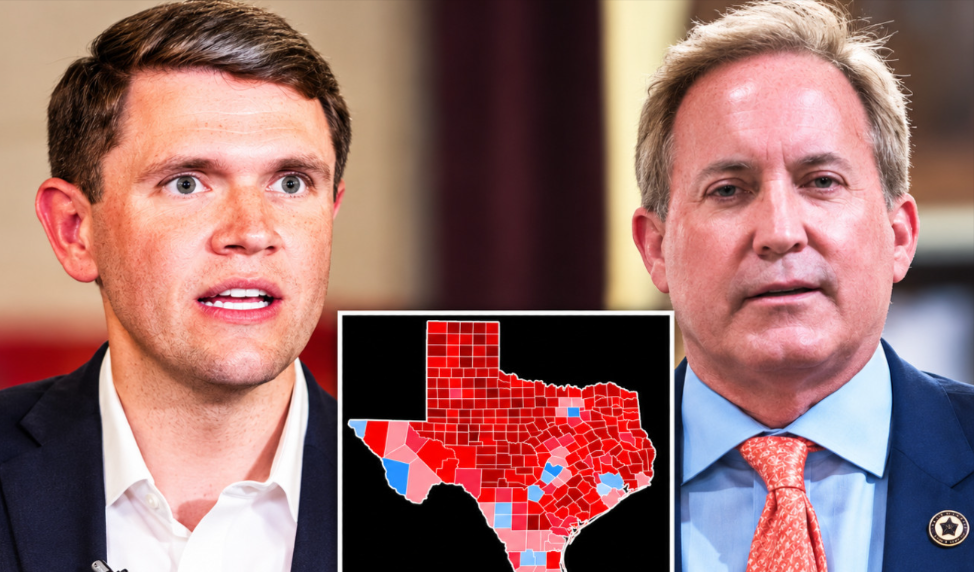
Republicans received a potentially favorable signal from Texas early voting data Thursday, as an independent election analyst reported a six-figure modeled GOP advantage in the state's closely watched U.S. Senate contest.
The October 22 assessment from election analyst E DataGuy estimated that Republicans had established a 255,144-ballot advantage based on his classification of early and mail-in voters.
His analysis covered a reported 2,208,661 ballots cast or returned ahead of the November 3 midterm elections.
According to the graphic, approximately 1,216,110 ballots were classified as Republican, while 960,966 were categorized as Democratic.
Another 16,263 ballots appeared in a separate category, although those three figures totaled 15,322 fewer ballots than the overall number reported in the graphic.
The analyst described the estimated Republican margin as an electoral firewall and characterized the Texas Senate contest as leaning toward the GOP.
His model projected Republican support ranging from 52% to 58%, compared with an estimated Democratic share of 40% to 46%.
The forecast also assumed statewide turnout would eventually reach 55%.
Those estimates, however, are not official vote totals or independently verified election results.
Texas does not register voters according to political party, meaning election officials cannot identify a Republican or Democratic vote simply from a returned ballot.
The analyst's calculations rely on an undisclosed combination of voter information and modeling assumptions, and the publicly shared graphic does not fully explain its methodology.
Official turnout trackers independently confirmed that more than 2.2 million Texans had participated in early voting by this stage of the election, although their cumulative totals differed from the analyst's snapshot.
The estimates arrive during an increasingly competitive Senate battle between Republican Texas Attorney General Ken Paxton and Democratic state Representative James Talarico.
The November election will determine who succeeds Republican Senator John Cornyn, whose defeat in the GOP primary cleared the way for Paxton's nomination.
Texas Republicans are defending a Senate seat that has remained in GOP hands for decades.
The state has not elected a Democrat to statewide office since the 1990s, making the contest particularly significant for both parties.
While the early voting model suggests a Republican advantage, independent polling has offered a different picture.
A RealClearPolitics polling average covering September 24 through October 14 showed Talarico ahead of Paxton by approximately 2.2 percentage points, according to CBS Texas.
Those competing indicators illustrate the uncertainty surrounding the race rather than establishing a definitive advantage for either candidate.
Meanwhile, Republicans have substantial financial resources supporting their nationwide campaign operations during the final weeks before Election Day.
President Donald Trump's flagship super PAC, MAGA Inc., has deployed nearly $277 million since the beginning of September to support Republican congressional candidates.
The spending represents an unusually large financial commitment by political organizations associated with a sitting president during a midterm election cycle.
Federal campaign finance disclosures show that much of the money has moved through affiliated political committees responsible for advertising in competitive races.
MAGA Inc. transferred $200 million to No Going Back PAC and another $25 million to Safety & Affordability PAC.
Those organizations have financed extensive advertising campaigns targeting important Senate and House contests, including the race in Texas.
The spending figures include transfers between political organizations and should not be interpreted as exclusively direct advertising purchases by MAGA Inc.
Despite its aggressive financial activity, the super PAC reported retaining more than $164 million in available cash as of October 14.
The organization had entered September with approximately $416 million, providing considerable financial capacity for the final stages of the election cycle.
Those figures reflect different reporting periods rather than separate pools of money available simultaneously.
TEXAS - 10.22.26
— E_DataGuy (@E_DataGuy) October 22, 2026
🗳️ 2,208,661 votes in
🔴 Firewall of 255,144
🥇Race is leaning Republican pic.twitter.com/ifJERvYEim
Trump has also publicly discussed a broader political spending operation exceeding $400 million by Election Day.
That commitment covers advertising, voter outreach, campaign rallies, telephone events and efforts to encourage election participation.
The president's political network has received significant contributions from wealthy donors, including businesswoman Diane Hendricks, Blackstone executive Stephen Schwarzman and casino entrepreneur Steve Wynn.
September financial disclosures identified an $8 million contribution from Wynn, alongside $5 million contributions associated with Hendricks and Schwarzman.
Federal law allows super PACs to accept unlimited contributions, although restrictions prohibit certain forms of coordination with candidates and their official campaigns.
The scale of Republican spending has become an important element of the national battle for control of Congress.
Trump-aligned groups have committed significant resources to competitive Senate elections, including contests in Ohio and Michigan.
The National Republican Congressional Committee has separately reported raising approximately $50 million during the third quarter of 2026.
According to its fundraising announcement, the committee entered October with roughly $61 million available for the closing weeks of the election.
That money primarily supports Republican House candidates and cannot be counted as direct funding for Paxton's Senate operation.
Democratic candidates and organizations are also spending heavily, including Talarico's campaign and outside groups supporting his candidacy.
The Associated Press reported that Trump's political network had spent extensively in Texas while retaining substantial reserves for additional campaign activity.
The late advertising push has also presented financial challenges, with limited television inventory driving up the price of available placements in certain markets.
Beyond fundraising and early voting participation, the Texas Senate contest has exposed tensions within Republican leadership.
Trump has publicly criticized Cornyn and longtime Republican strategist Karl Rove, accusing both men of undermining Paxton's general election campaign.
The president's remarks followed Cornyn's defeat in the Republican primary runoff, a contest in which Trump ultimately supported Paxton.
Despite the primary outcome, Cornyn has declined to endorse Paxton and previously indicated that he did not intend to direct campaign funds toward his former opponent.
Rove, a former senior adviser to President George W. Bush, has also criticized Paxton's candidacy.
Trump responded on October 15 with an unusually sharp Truth Social statement assigning potential responsibility for a Republican defeat to the two establishment figures.
The president accused Cornyn and Rove of “doing everything possible to make it hard” for Paxton to defeat Talarico.
He then escalated his criticism in a direct warning.
“If Ken Paxton loses, it will be because of WEAK and INEFFECTIVE Political Hacks like John Cornyn and Karl Rove, who have ineffectively opposed me for my entire political career,” Trump wrote on Truth Social.
Trump's comments reflected an ongoing dispute over party loyalty following a contentious Republican primary.
The president also called on former Cornyn supporters to unite behind Paxton, arguing that divisions within the GOP could damage the party's prospects in the general election.
Rove subsequently dismissed Trump's criticism and questioned the president's assessment of his influence over the race.
The disagreement comes as Paxton attempts to consolidate Republican support while Talarico courts moderate and independent voters in the traditionally Republican state.
For Republicans, the final stretch combines extensive campaign spending, a closely watched Senate contest and competing interpretations of early voter participation.
The October 22 model provides one estimate suggesting stronger Republican participation, but it does not establish how those voters actually cast their ballots.
Texas early voting continues through October 30, with the general election scheduled for November 3.
Until those votes are counted, the reported Republican firewall remains an analytical projection rather than an established electoral result.
The outcome will be determined by the full electorate, including voters who have yet to participate, as both parties continue their final campaign efforts across the state.